 Por Luis Ernesto Martínez González
En 1888 José Martí escribió un amplio artículo acerca de un libro sobre Guatemala. El título del escrito martiano es “Guatemala, la tierra del quetzal. W. T. Brigham”, y se publicó en El Economista Americano, de Nueva York, en enero de 1888.
Acerca de este texto senaló el Apóstol:
“Desde el noble prólogo dice bien este libro honrado de su autor, que en él revela la cualidad, rara en los viajeros, de juzgar los países con arreglo a sus elementos e historia, y no a los cánones de la raza del crítico. No llega en el autor la fantasía, que por todas partes apunta y realza la obra, al grado de síntesis que pide el arte; ni los materiales, allegados con escrúpulos, se eslabonan y ayudan como pudiesen, en manos más acostumbradas a urdir libros; pero la nota fiel, la narración personal y viva y la cordialidad que hermosea estas laboriosas páginas; excusan de sobra algún error de juicio o equivocación histórica; como cuando supone a México, cuya historia real pasma y conforta, inferior en carácter y recursos a la tierra del quetzal indómito, menos varia y pujante; o cuando presenta como víctima de desórdenes y guerras a ese ameno rincón de Nicaragua, que es, en su pequeñez, como Suiza de América y ejemplo de repúblicas”.
“El mérito del libro de Brigham está, sobre todo, en tal fidelidad a lo que ve, que, sin afear con la preocupación ni adornar con la simpatía el país fértil y modesto por donde viaja, queda éste pintado por manos extranjeras como lo hubiese descrito un buen observador indígena”.
“Ni el opresor halla excusa ¡indecorosa para quien la ofrece!, ni el oprimido desdén injusto, en este libro que, para retrato del país y enseñanza de los norteamericanos, fue Brigham escribiendo, sin disimular flaquezas ni escatimar méritos…”.
“…él, ganado con la energía del orden natural lo que pierde con la falta de orden literario, resume el viaje, narrando amenamente, en un capítulo de opinión, donde resulta amable, a pesar de sus trabajos de comienzo, la República; y en este libro, que en una noticia sobre volcanes y terremotos cuenta la historia de aquella naturaleza fragante, halla lugar, con ayuda del buen obispo Juarros y el capitán Fuentes, de la Recordación Florida, y el Popol Vuh, que tradujeron Brasseur y Ximenes, y Milla, que tomó su historia de éstos, para narrar en fieles versículos la pintoresca creación de la biblia quiché…”.
En su reseña, José Martí incorporó frases traducidas del libro, las cuales se presentan a continuación con el original en inglés:
“«Amo los trópicos»…”: “The real trouble that meets the novice on the threshold of the tropics is the utter inadequacy of the English language to express the variety and luxuriance he sees in the vegetable world” (p.323) y “It has been my fortune to visit many of the tropical regions of the world, and I have visited them not from idle curiosity, but with a genuine interest in their inhabitants and productions”. (p.338)
“…«no sería viaje de recreo el que hubiera de hacer por entre cloacas de engaño y montes de tiranía»”: “I do not care to follow the history of Guatemala under Spanish rule; it would be no pleasure excursion through the sloughs of deceit and over mountains of tyranny”. (p.270)
“…«pueden compararse con ventaja a los gobernadores de cualquiera de los Estados del Norte de la Unión Americana?»”: “The Executive appoints over each of these Departments a Jefe politico, or civil governor; and, like the Secretaries of State, they must be men in whom he has implicit confidence. I may add that I met fifteen of these Jefes in the course of my journey, and found them, with two exceptions, men of character and intelligence, who would compare favorably with the governors of any of the Northern States; nor is this surprising, since they are appointed for their fitness, and not elected, as the United States governors often are, by a handful of irresponsible politicians who use popular votes simply to forward their private ends”. (pp.294-295)
“…«un Cristo de cuyas heridas salen imitando la sangre hilos carmesíes, y a cuya izquierda llora con un pañuelo de finísimo encaje, junto a los soldados romanos, un general guatemalteco?»”: “Near the main entrance was a large altar-piece, with a deeply sunken cruciform panel containing a very realistic crucifix, —glass eyes, sweat, long hair, and blooddrops, indeed, everything that could make it disgusting to a civilized being; while from the five wounds proceeded skeins of crimson thread, —that from the side being much thicker, —and all these knotted together in a mass, black with the kisses of the worshippers of the blood of Christ. On one side of this panel were painted, life-size, Roman soldiers mocking the suffering Saviour; while on the other was a Guatemaltecan general, in full uniform, weeping at the sad sight, and using such an embroidered handkerchief as the nuns make at the present day”. (p.133)
“«Amontonados en una sacristía vi cabezas y pies y brazos de santos, y barbas y pelucas, y un Cristo con las piernas combas y argolla en los tobillos, para atarlo a la mula el Domingo de Ramos»”: “In the old lumber-room of the church were the remains of an ancient organ, and heads, bodies, and arms of saints,—not relics, but the membra disjecta of the dolls that are put together and dressed up on holy-days. We had often seen similar places, which Frank called «property-rooms»; in one we found boxes of wigs and beards, and in another a figure of Christ with permanently bent legs, and staples in his ankles to strap him on to the mule on Palm Sunday!”. (pp.142-143)
“«Yo, que en la cumbre del Sinaí, y ante Buda gigantesco, y frente a los dioses de Cantón y el Júpiter del Vaticano, he sentido animarse mi imaginación, nada solemne ni santo hallé en el santuario de Esquipulas, el santuario del Cristo negro, a no ser el retrato del primer arzobispo de Guatemala, Don Pedro Pardo de Figueroa»”: “It was impossible for me to feel any of the awe with which past generations of Indios have regarded this black Christ. My imagination is not wholly dulled, and I have felt curious sensations before the horrible idols of the Pacific islanders, before the placid features of a gigantic Buddha, in the Hall of Gods at Canton, and before the Jove of the Vatican. I have been in the holy places of many nations, and have felt a sympathy with the worshippers; even the black cliffs of the supposed Sinai have led my thoughts captive. But here in Esquipulas there was nothing but the husk,—nothing solemn, nothing holy; the portrait of Figueroa was the most respectable thing in the church”. (p.204)
“«Aquellas imágenes—dice en otro lugar—me causaron repulsión mayor que cuando me detuve en el umbral del santuario de Kali, en la vecindad de Calcuta, y vi el ídolo odioso con los labios untados de sangre, y caído al pecho el collar de cabezas»”: “God had a white beard and laid head, while Christ’s hair was black. Neither this Quaternity, ncr anything else we noticed in the service of religion here, surprised me; though the shudder of disgust was stronger than when I stood on the threshold of the sanctuary of Kali, near Calcutta, and saw the hideous idol with its gory lips and necklace of bleeding human heads”. (pp.149-150)
“…«mucha labor durable y bella»…”: “This is the centre of the trade in native cloths; and many beautiful and durable fabrics are woven here and in the neighborhood from cotton and wool”. (p.141)
“…«¡Pues hazlas para mañana, o lo vas a pagar caro!»”: “His little daughter, who had been educated in New York, acted as his interpreter; and never, among the scores of interpreters I have had in many countries, have I found so capital a one. Once only my Spanish failed me; and instantly the little girl repeated in idiomatic, concise English, her father’s question. I told him I had more important business with him at the capital, but that at present I wished only the privilege of hiring or purchasing bestias for our journey to Solola. He at once summoned the stupid little Jefe and asked him why he had not furnished us as we requested. «No hay» (there are none), replied the Indio. «Then make some before to-morrow, or you shall suffer for it!» said President Barrios; and told me to let him know if they were not furnished us in the morning”. (p.150)
“…«El herrero que tiene clavos no tiene martillo»…”: “There were three herreras in the town; but one was sick, another had no charcoal, while the third had no nails, —and there was no lending among these sons of Thor”. (p.210)
“…«en la Antigua las tallan mejor que en Dieppe»…”: “There are two industries in Antigua of considerable interest to the visitor,—the carving of cane-heads, which is done in a most artistic manner, equalling, perhaps, the famous ivory carvings of Dieppe, in Normandy…”. (p.162)
El libro
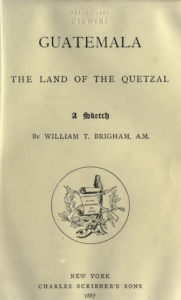
Los datos de portada de este libro son los siguientes:
Guatemala, the land of the quetzal. A sketch. By William T. Brigham, A.M. New York. Charles Scrinber’s Sons. 1887.
Este libro tuvo en el mismo año una segunda edición: Guatemala, the land of the quetzal. A sketch. By William T. Brigham, A.M. London. T. Fisher Unwin. 26 Paternoster Square. 1887. Esta edición coincide en su paginado con la primera.
El autor
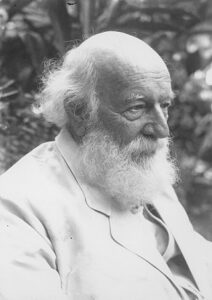
William Tufts Brigham (1841–1926) fue un etnólogo estadounidense. Hizo sus primeros estudios en Boston. Asistió a la Universidad de Harvard, donde se graduó en 1862. Inicialmente se dedicó a la botánica y entre 1864 y 1865 investigó la flora de Hawai junto a Horace Mann Jr. En 1867 comenzó a impartir clases de botánica en Harvard. Después de un año vinculado a la docencia se dedicó los trabajos científicos relacionados con la geología, la sismología y la botánica, aunque sobresalió por sus artículos y libros relacionados con la etnología, en especial de Centroamérica y Hawai. Se estableció en Hawai, donde fue el primer director del Bernice P. Bishop Museum de Honolulu.
Publicó numerosos libros, como Cast catalogue of antique sculpture; With an introduction to the study of ornament (1874), Hawaiian Kapas from the Collection in the Bernice Pauahi Bishop Museum of Ethnology and Natural History (1893), Hawaiian feather work (1899), An index to the islands of the Pacific Ocean : a handbook to the chart on the walls of the Bernice Pauahi Bishop Museum of Polynesian Ethnology and Natural History (1900), A handbook for visitors to the Bernice Pauahi Bishop Museum of Polynesian Ethnology and Natural History (1903), Additional notes on Hawaiian feather work (1903), Old Hawaiian Carvings: Memoirs the Bernice Pauahi Bishop Museum (1906), The ancient Hawaiian house (1908) y The volcanoes of Kilauea and Mauna Loa on the island of Hawaii: their variously recorded history to the present time (1909). (ALH)