 Por Luis Ernesto Martínez González
En un libro sobre el socialismo, José Martí dejó múltiples evidencias de las estrategias de aprendizaje que utilizó.
Un ejemplar del libro Contemporary Socialis, edición de 1887, perteneciente a su biblioteca, José Martí dejó múltiples fragmentos subrayados y anotaciones al margen hechas a lápiz.
El libro
Contemporary Socialism. By John Rae, M. A. New York. Charles Scribner’s Sons. 1889.
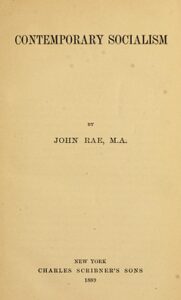
Este libro se publicó por vez primera en 1884 y tuvo otras ediciones en 1891, 1901 y 1908. Un ejemplar de la edición de 1887, perteneciente a la biblioteca personal de José Martí, contiene fragmentos subrayados y anotaciones al margen hechas a lápiz. De acuerdo a la edición de 1889 se trata de los siguientes:
En el primer capítulo, titulado “Introductory”:
Aparece la siguiente frase subrayada: “It is the democratic communism of the Young Hegelians, and it scouts the very suggestion of State-help, and will content itself with nothing short of State-transformation”. (p.3)
Subrayó un fragmento citado de un libro de un economista inglés que plantea: “…but it seems to me that the idea which «socialism» conveys to most minds is not that of any particular form of society to be realised at a future time when the character of human beings and the conditions of human life are widely different from what they now are, but rather certain modes of action, more especially the employment of the powers of the State for the instant accomplishment of ideal schemes, which is the invariable attribute of all projects generally regarded as socialistic”. (pp.7-8) El libro citado fue: Leading Principles of Political Economy, p.316.
Aparece este párrafo subrayado: “But these differences are only refinements on Baboeuf’s plan, and its main features remain—equality of conditions, nationalisation of property, democratic tyranny, a uniform medium fatal to progress, an omnipresent mandarin control crushing out of the people that energy of character which W. von Humboldt said was the first and only virtue of man, because it was the root of all other excellence and advancement”. (pp.18-19)En el margen superior de la página 19 anotó: “En vez de igualdad imposible, equidad posible”. En el margen inferior aparece esta nota: “Democracia no es el gobierno de una parte del pueblo o una clase del pueblo sobre otra, porque eso es tiranía. Sino el gobierno de tanto el pueblo en equitativa representación y el equilibrio de las clases, de modo que siempre quede [ilegible] parte que la han de representar”.
En el margen izquierdo de la página 20 aparece la siguiente nota: “Conciliar la energía creadora del hombre en el combate humano, fuente inevitable de todo progreso, con una garantía tal que le quite su acerbidad y dureza sin quitarle el estímulo. Aumentar la energía del hombre con la certeza de su premio tanto como se la [ininteligible]”.
En los márgenes izquierdo, superior y derecho de la página 21 anotó: “No soy yo el que llego, esto no es para mí. Yo soy viento y humo. Ahí marchan, marchan y vengo como [ilegible]”.
Una nota manuscrita en la página 22 dice: “Artículo (Gómez) sobre el militarismo, leer? Bolívar”.
La página 23 tiene anotaciones en tres márgenes, pero las pocas palabras que se pueden leer dicen: “El negro es tan capaz como el blanco”.
Hay unas líneas subrayadas en la página 31: “The stability of Europe may be said to rest on the number of its comfortable peasantry; the dam of the Revolution is the small farm”.
En un párrafo de las páginas 33-34 sobre las condiciones para la aparición del socialismo, aparece subrayado este fragmento: “…where previous revolutions have left behind them an unquiet and revolutionary spirit—a «valetudinary habit», as Burke calls it, «of making the extreme medicine of the State its daily bread.» That is very much what we do find. All these conditions are present in Germany—the country in which socialism has made the most remarkable and rapid advance”.
Sobre la situación del campesinado en Alemania, subrayó estas líneas en las páginas 34-35: “But while thus in the west the agricultural population suffers seriously from the excessive subdivision of landed property, they are straitened in the eastern and northern provinces by their exclusión from it”.
Otro pasaje subrayado, esta vez en la página 47, fue: “The condition of Switzerland shows us clearly enough that democracy under a régime of freedom lends no ear to socialism, but sets its face in entirely different directions”.
En un párrafo que trata de las ideas socialistas en Italia, aparece subrayado este fragmento: “…of its exceptionally numerous body of enthusiastic young men without career or prospects ; and certainly revolutionary elements abound in the peninsula, but as M. de Laveleye shrewdly remarks, a revolution is perhaps next to impossible for want of a revolutionary metropolis”. (p.53)
En el segundo capítulo, titulado “Ferdinand Lassalle”:
Subrayó en un párrafo acerca del político Ferdinand Lassalle lo siguiente: “…and he then declared boldly in his defence that he was a socialist democrat, and that he was «revolutiunary on principle». This he remained throughout, lie laughs at those who cannot hear the word revolution without a shudder. «Revolution», he says, «jeans merely transformation, and is accomplished when an entirely new principle is—either with force or without it—put in the place of an existing state of things”. (p.66)
Otras palabras subrayadas se relacionan con los criterios de Lassalle sobre la resistencia armada: “…«Passive resistance is a contradiction in itself. It is like Lichtenberg’s knife, without blade, and without handle, or like the fleece which one must wash without wetting. It is mere inward ill-will without the outward deed. The Crown confiscates the people’s freedom…”. (p.71)
En el octavo capítulo, titulado “Socialism and the social question”:
En una parte referida al salario de los obreros, subrayó: “The price of labour is now determined by a struggle between the labourer and the employer, and the fortunes of the struggle move between two very real, if not very definitely marked, limits, the lower of which is constituted by the smallest amount which the labourer can afford to take, and the higher by the largest amount which the employer can afford to give”. (p.333)
En los márgenes de las páginas338-339 escribió en relación con el trabajo del obrero: “Lo que hay que establecer es la naturaleza meritoria del hombre, y basar en ella, y en las necesidades y propósitos [ilegibles] […] el estímulo personal o colectivo del trabajo [ilegible] […] que trae consigo o las ha traído por no emplearlas”.
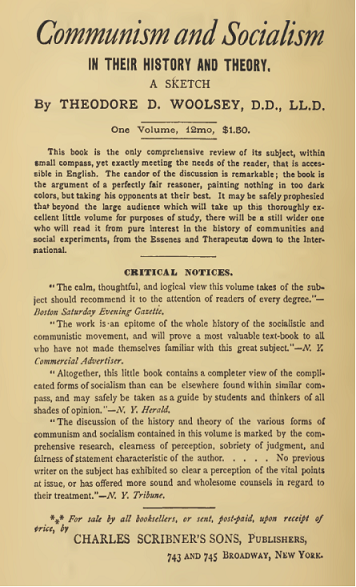
En el margen inferior de un anuncio sobre el libro Comunism and Socialism in their history and theory. A sketch, de Theodore D. Woolsey, que aparece al final del texto sin paginar, escribió: “Arriba, arriba! Lo hecho no es mucho [ilegible]”. (p.61) El anuncio al que se hace referencia es el siguiente:
Sobre este tema puede consultarse el artículo de José Ballón: “J. Martí y El socialismo contemporáneo de John Rae”, Anuario del Centro de Estudios Martianos, 16, La Habana, 1993, pp.50-62.
El autor
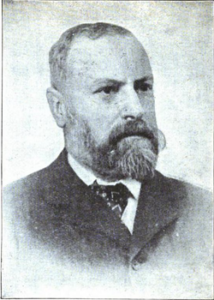
John Rae (1846-1915) fue un escritor y periodista escocés. Se desempeñó por largos años como editor en The Contemporary Review. Colaboró con The British Quarterly Review y The Economic Journal. Entre sus obras más conocidas se incluyen además Eight Hours for Work (1894) y Life of Adam Smith (1895).